
Aviation & Asset Finance | JVS Law
When a foreign lessor, bank or insurer meets a Ukrainian deal for the first time, it rarely starts with Ukrainian statutes. It opens a comparative guide and reads the Ukraine chapter — because the questions are the same as in every other jurisdiction and the answers can be laid side by side.
Contents
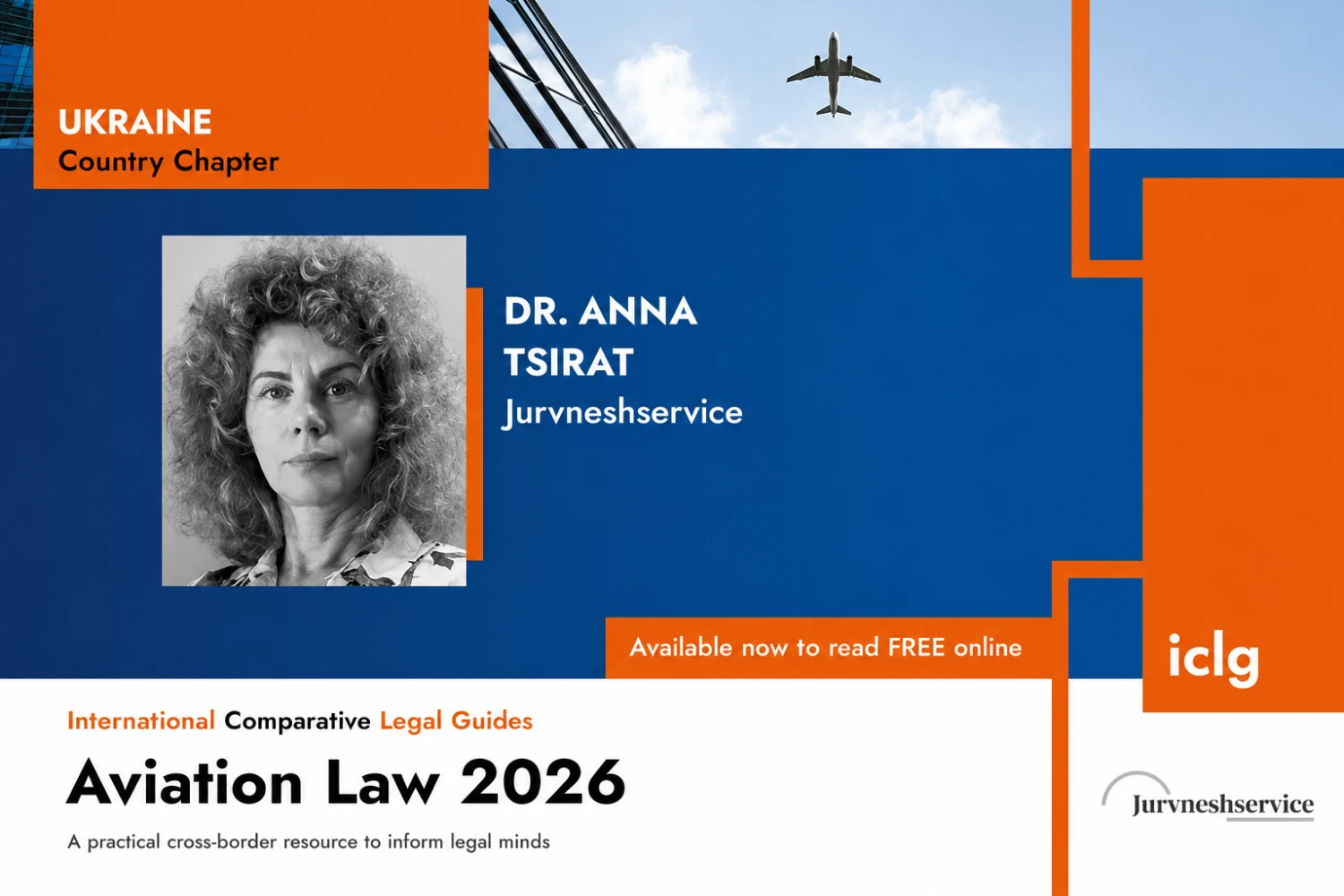
Dr Anna Tsirat has written those chapters since 2016. Below: what is current, the three answers from the current chapter that most often surprise foreign counsel, and the full list of editions with the texts we hold.
What is current
ICLG – Aviation Law 2026. Chapter 26 of the 14th edition. The guide covers regulation and air safety, rights in aircraft, detention against unpaid debts, which courts hear aviation disputes, and a commercial block running from airports to passenger rights on delay. Read online · PDF
ICLG – Aviation Finance & Leasing. A separate guide from the same publisher, going deeper into financing: the structures available to acquire an aircraft and their trade-offs, the types of leasing actually used in Ukraine, and the tax consequences. The Ukraine chapter has run since that guide’s first edition in 2020. Read online — as at the date this page was updated, the edition served there is 2023.
ICLG keeps only the current edition at each address: when a new one appears, the previous edition drops off that URL. That is why the texts we hold are listed below.
Three answers that most often surprise
Registration of an aircraft does not prove ownership. An entry in the Ukrainian Aircraft Register records who is stated to be the owner but does not establish title — title is proved by the underlying documents. In practice the SAAU accepts an FAA Form 8050-2 Aircraft Bill of Sale, or an equivalent, as sufficient for registration. For a buyer that means the certificate of registration is no substitute for a title chain review.
There is no national register of aircraft mortgages or charges at all. All international interests are registered with the International Registry under the Cape Town Convention. To make an entry, the lessor or financier must first obtain an Authorising Entry Point code from the SAAU — filing an application that identifies the interest and the supporting agreements — and only then register directly with the International Registry. It is a procedural step easily missed when planning a closing timetable.
Unpaid VAT does not create a lien over the aircraft. Aircraft under the temporary admission regime are exempt from 20% VAT for up to three years, extendable, provided they are re-exported. In leasing structures the lessee bears import VAT and — the point that matters to a creditor — a tax lien may attach only to assets owned by the taxpayer, so it does not reach the lessor’s aircraft. Ukraine imposes no stamp, registration or documentary taxes on aircraft sale, leasing or finance documents, or on payments under them.
All editions
Ukraine chapters in international aviation guides, by edition. Where we hold the text, it is here.
ICLG – Aviation Law (Global Legal Group)
- 2026 — 14th edition, Chapter 26. PDF
- 2025 — previous edition.
ICLG – Aviation Finance & Leasing (Global Legal Group)
- Ukraine chapter since the guide’s first edition in 2020; the publisher’s page currently serves the 2023 edition.
Aviation Finance & Leasing (Law Business Research, contributing editor Mark Bisset)
The Aviation Law Review (Law Business Research)
- 2016 — PDF
Ukraine — Law and Practice, the aviation chapter of an international practice guide
- Written by Ganna Tsirat, referring to the Code on Bankruptcy Procedures in force from 21 April 2019. PDF
Where to read further
A guide gives a short answer to each question. Where a topic needs the longer treatment, we have written it separately:
- Ukraine’s Cape Town declarations — Alternative A with a 60-day waiting period, IDERA, and the declaration that remedies the Protocol does not expressly send to court may be exercised without leave of the court. The most creditor-friendly set in the region, and it shapes your repossession position more than the lease does: what the Cape Town declarations actually give you.
- The sector as a whole — regulation, post-war opportunities and risks: aviation law in Ukraine.
- Airports — all owned by the state or local communities; concessions and PPPs were under consideration before February 2022 and survive in recovery planning: airport governance models.
And one point from the licensing block worth knowing at the structuring stage: a Ukrainian air carrier must be at least 50% owned by Ukrainian persons and hold a valid Air Operator Certificate; the responsible ministry then issues the operating licence within 10 days, absent grounds for refusal.
Financing or leasing an aircraft into Ukraine?
We prepare legal opinions for lessors, banks and export credit agencies, structure security, handle International Registry filings and act on repossession following default. Send us the deal structure — we reply within one business day.
Dr Anna Tsirat: profile and enquiry form →
Practice: Aircraft Leasing, Acquisition & Repossession · Aviation Regulatory & Compliance
Page updated 13 August 2026. Details of the current chapter are taken from the publication itself: International Comparative Legal Guides – Aviation Law 2026, 14th edition, Chapter 26 “Ukraine”, by Dr Anna Tsirat, Jurvneshservice; contributing editors Alan D. Meneghetti (Ipeco) and Philip Perrotta (K&L Gates). Quoted answers follow the published text of the chapter. Publishers refresh these guides annually and usually keep only the current edition at a given address — a year in the list above is the year of the edition, not the date it was last checked.