
A year has passed since the crash of the flight PS752. The technical investigation has not been completed, and its results have not been made public. Iran is not fulfilling its obligations as to such an investigation under the Chicago Convention. We analyze the status of compensation payments to the relatives of victims of the flight PS752. The current situation demonstrates the lack of prospects for a quick settlement from the Iranian side. In contrast, Canadian and Ukrainian governments and relatives show a willingness to punish the perpetrators and prevent similar future situations, even though that may delay fair compensation.
Contents
- 1 Prehistory
- 2 Preliminary payments to victims’ relatives
- 3 Compensation to passengers’ relatives
- 4 Compensation to crew’ relatives
- 5 Court proceedings against UIA
- 6 Court proceedings against Iran
- 7 How the claims against UIA ended
- 8 What a passenger is worth today
- 9 There is a judgment; there is no money
- 10 The three other tracks
Updated in August 2026
What follows was written for the first anniversary of the crash, in January 2021. We have left it untouched: it records what was known then and what predictions followed from it. Five years on, the main questions have answers, and those are set out in separate sections at the end.
Prehistory
Source: www.international.gc.ca
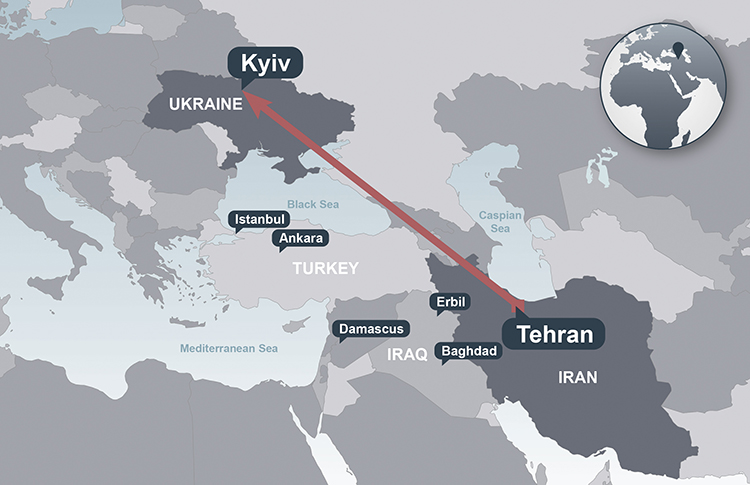
A UIA scheduled passenger flights PS752 from Tehran to Kyiv was beaten in 3 minutes after takeoff by Iran’s air defense missile on 8 January 2020. 176 people, including 9 members of the crew, were killed.
Although mostly all passengers of the flight PS752 had Iranian origin, they were citizens of different countries: 90 – from Iran, of which 30 were permanent residents in Canada, 55 – from Canada, 11 – from Ukraine (2 passengers and 9 crew members), 10 – with Sweden, 7 from Afghanistan and 3 passengers – citizens of Great Britain. International Coordination and Response Group for the victims of flight (International Group) was created to help bereaved families.
The first meeting of the International Group took place in London on 16 January 2020. There a framework for a settlement with Iran was developed, including requirements for completing the Chicago Convention accident investigation, prosecution of perpetrators, transparency, and justice for families of the victims, and the payment of timely and fair compensation commensurate with previous similar tragic cases.
On 2 July 2020, members of the International Group signed a memorandum of understanding on negotiations with Iran to pay compensation to the victims’ relatives. This memorandum reflects the terms of the International Group’s joint work and formalizes how it will cooperate before and during negotiations with Iran.
Since Canada and Sweden do not have diplomatic relations with Iran, and diplomatic relations between Iran and the United Kingdom deteriorated in mid-January 2020, the Ministry of Foreign Affairs of Ukraine (MFA) was elected a spokesman for the International Group. A representative from each member country of the International Group was appointed to the Advisory Committee, whose members should be present during the spokesman’s negotiations with Iran to support its work.
The first round of talks with the Iranian delegation on resolving issues related to the downing of PS752 took place on 31 July 2020. Among the priorities for solving the MFA put an objective, impartial investigation of the accident and obtaining assurances from Iran not to repeat similar accidents in the future.
The second round of talks between Iran and Ukraine took place on 18 – 21 October 2020 in Tehran. Although the Iranian side confirmed that the investigation would be conducted under the Chicago Convention requirements, no relevant reports on the investigation results were provided.
Preliminary payments to victims’ relatives
As early as 17 January 2020, the Government of Canada decided to pay Canadian citizens and permanent residents (a total of 85 people) С$ 25,000 for each passenger killed as assistance in their immediate funeral and travel needs. The Government of Canada has also initiated a collection of donations to families. A total of C$ 3.29 million was raised, including C$ 1.5 million provided by Canada’s Government. It is planned to use this money for the long-term support of the victims’ heirs’ families[1].
The Ukrainian government also paid UHR 200,000 ($ 7,142) to the dead Ukrainians’ families almost immediately after the disaster.
We hope that the governments of Sweden, Great Britain, and Afghanistan financially supported dead passengers’ relatives, although we could not find information about it.
UIA advanced 16 000 SDR (about $ 22,000) to relatives of each victim passenger under Rules No. 1239 of air transport and handling of passengers and baggage, approved by the State Aviation Service (the Air Transportation Regulations).
As Iran was forced to admit its guilt in the plane’s illegal downing, it was expected that after completing the investigation of the crash, joint negotiations would determine compensation to be paid to each relative of the dead. Though Iran’s draft budget for 2021 set the amount of € 200 mln to pay such compensation, this amount was withdrawn for unknown reasons. Iranian state television stated about the government’s readiness to allocate $ 150,000 for each victim without specifying any payment terms at the end of December 2020. Neither the International Group nor MFA has received any formal proposals for compensation.
In general, the situation remains uncertain regarding due investigation reports and amounts to be compensated to the victims’ relatives.
Compensation to passengers’ relatives
As PS752 was an international flight, the carrier shall reimburse damage under the international private air law rules. This area is regulated by two universal Conventions with the same name – the Unification of Certain Rules Relating to International Carriage by Air, signed at different times.
The first convention was signed in Warsaw in 1929, and because of this, it was named Warsaw. According to its rules, the carrier was obliged to pay the deceased passenger’s relatives an amount equivalent to $ 8,000 in the absence of guilt. In the case of its fault, the airline has to compensate for the proved injury and damage. The Warsaw Convention was amended heavily to increase the amount of payment to the injured passenger. These treaties created the “Warsaw system” of the carrier’s liability. The established carrier liability system’s disadvantage was the actual lack of a uniform amount to be paid. Not all parties to the Warsaw Convention became parties to other international agreements and private initiatives that amended it. In the event of an accident, it is necessary to find out which of the Warsaw system documents should establish the carrier’s amount of liability for causing harm to the health of the passenger. Thus, UIA had to pay $ 20,000 to each dead passenger’s heirs from Afghanistan and Iran, as these countries and Ukraine are parties to the Warsaw Convention and the 1955 Hague Protocol.
The Convention for the Unification of Certain Rules for International Carriage by Air signed in Montreal in 1999 was adopted to correct the Warsaw Liability System’s shortcomings. The Montreal Convention codified the Warsaw treaties’ provisions and private initiatives that proved successful. The Montreal Convention provides that in the absence of negligence on the carrier’s part, he must pay the family of each deceased passenger amount of 128 821 SDR, which is around $ 185,536. Ukraine, Canada, Sweden, and the United Kingdom are parties to the Montreal Convention. Accordingly, compensation to the heirs of the victims from these countries shall be paid in the stated amount.
Since 2019 Ukrainian airlines, including UIA, are guided by the Air Transportation Rules applied to home and international air flights. They provided first tier level compensation in the amount of SDR 250 000[2], which is about $ 360,067 for each dead passenger unless it is proved negligence by the carrier. We believe UIA should pay 250,000 SDR compensation to each deceased heirs as the Rules provide for a much higher amount of payment than international treaties.
Reinsurers[3] make the compensation payment as both international private and local air laws provide carriers’ liability for adequate insurance, which is just 250,000 SDR ($ 360,067).
Compensation to crew’ relatives
Warsaw and Montreal Conventions cover only the passengers but not members of the crew. Reimbursement to the relatives of the crew was made under the national laws of Ukraine.
The UIA flight crew consisted of three experienced pilots[4]and six flight attendants. Each crew member had to be insured in the amount of 300 000 UAH ($ 10,714) according to the regulation of the Cabinet of Ministers of Ukraine № 676 “Procedure and rules for the implementation of mandatory aviation insurance of civil aviation.” The flight attendants were most likely insured for this minimum amount, and perhaps only the pilots had slightly higher insurance. However, even this isn’t very certain, as Ukrainian pilots do not care about their insurance level when concluding employment contracts with airlines. As the crew died, the relatives of the victims had to receive the amount of their insurance.
The Law “On Compulsory State Insurance” provides for the payment of one-time assistance to the family of each deceased crew member for 202,700 UAH ($ 7,240). Every child of the dead pilot by the same law was paid a lump in 40,540 UAH ($ 1,448). Until reaching the age of majority, these children are entitled to monthly insurance benefits in the amount of the deceased pilot’s average monthly earnings, but not more than 10 of the subsistence level set for non-disabled persons. Today this amount is $ 782.
UIA paid financial assistance to the relatives of 9 crew members under the collective employment agreement. As we heard, the amount per each was 1 mln UAH ($ 35,714).
Thus, the compensation received by the heirs of the deceased crew members is much more modest compared to the amounts to be paid for the dead passengers.
Court proceedings against UIA
Heirs[5]of perished passengers can claim that the flight PS 752 indicates UIA negligence, and therefore the amount of compensation for each victim should not be restricted to $ 360,067. After all, just hours before the departure of PS 752, Iran launched a missile attack on two military bases in Iraq, where American and Canadian soldiers were stationed, in revenge for the assassination of General Kassem Solemeini. Air safety in the region was very tense, and American carriers did not fly there due to the US Federal Aviation Administration ban. UIA should act similarly. Proof of these claims must be made in court. The recent jurisprudence, including those associated with Malaysian Airlines flight H17, indicates that the court can be inclined to recognize UIA’s actions as negligent in this context.
The Warsaw and Montreal Conventions provide for several places for deceased passengers’ heirs to go to court. They can choose:
- to the court of Ukraine as the location of UIA and the location of its head office, or
- to the court at the place of carrier’s office through which the contract of carriage was concluded (i.e., purchased a ticket for international air transportation). According to the information posted on the UIA website, representation through which passengers could potentially found buy tickets was in Sweden, the UK, and Iran, or
- to Canada’s court as the passenger’s destination, which is the same as the “place of departure” for international round-trip transportation. The state in whose territory the passenger at the time of the accident had his principal and permanent residence. This jurisdiction will be available to the heirs of those deceased passengers who were Canadians and Iranians but resided in Canada.
In choosing the jurisdiction, the heirs will use the rules of international conventions and laws to be applied to their rights in determining the amount of compensation for damage.
Such compensation may be conditionally divided into two parts. The first includes damage for the passenger’s death, ticket, and the deceased’s things. A separate category of claims consists of the mental suffering of the dead. According to published information, 25 seconds passed between the two missiles that hit the plane. After the first missile hit, the pilots tried to control the aircraft for 19 seconds as the engines continued to run. At the time, the plane was at an altitude of 2416 m. Passengers in the cabin during those 25 seconds were able to realize that this is their last flight. Such an awareness had the consequence of their mental suffering. Although the laws of the United Kingdom, Canada, and Ukraine allow for the possibility of compensation for mental injuries that preceded the physical injury, only the laws of the United Kingdom and Canada qualify to inherit these requirements.[6] Accordingly, the courts of Ukraine are not an “attractive” place to hear disputes vs. carriers. Since most of the dead passengers came from Canada and bought there tickets, most court cases will be held in Canada.
The first part of claims includes loss of income and business or employment opportunities (most of the victims had higher education and worked as a specialty, and others studied in universities), financial and moral maintenance of family members, which could provide the deceased, funeral expenses. The exact amount of compensation to be paid must be determined by the court under applicable law.
The second part of the compensation claims relates to the payment of non-pecuniary damage suffered by the plaintiffs connected with close relatives’ death. These payments are defined as “comforting. “ Comforting amounts depend on the residence of the deceased before the accident. Though Canadian provinces’ laws are significantly different in payment of compensation for fatal accidents, they are usually considerable.
Many Canadian law firms offer bereaved families to file individual lawsuits against the UIA as the negligent carrier. These claims will be dealt with under the Montreal Convention, which places the burden of proving non-negligence on the airline. Per the plaintiffs’ responsibilities is only the submission of documents confirming their relatives’ tickets for the flight and their death and the formulation of amounts to be reimbursed. Individual lawsuits are more straightforward in court, and, accordingly, decisions are expected within two years from the date of filing the lawsuit. Because international conventions set a statute of limitations of two years for filing lawsuits against the carrier, such suits may be filed against UIA until early 2022.
Court proceedings against Iran
Everyone knows about three class actions against the Iranian government, the Corps of Islamic Revolutionary Guards, and senior Iranian officials[7]. Two of them have been submitted to the Ontario Supreme court of justice, and another one – to the US federal court.
Class actions to the Canadian court were submitted on 20 January 2020. UIA is a co-respondent in one class action. This lawsuit[8] is based on claims for compensation for damage caused by the Iranian military’s negligent acts, who confused a civilian aircraft with a missile. The class-action lawsuit seeks more than $ 2.5 billion in damages. Proper service of the claim on defendants, including the Iranian government[9], occurred. On 9 November 2020, the Ontario Supreme Court ruled[10] on its jurisdiction in this class action and appointed the judge. After a class-action lawsuit is filed, relatives of the victims who were not Canadian citizens may join it. According to media reports, some relatives of the crew have already expressed their desire to do so.
Another filed class action is based on Justice for Victims of Terrorism Act of Canada. The claim treats the Iranian government acts as terroristic. The total amount of his claims exceeds one billion US dollars. UIA is not a co-defendant in this lawsuit. Suppose the Government of Iran failed to reply to the claim before 30 October 2020. In that case, the Supreme Court of Justice of Ontario may decide “on default,” which means that the victims’ families can obtain a judgment based on the facts’ requirements in the lawsuit. The hearing is intended in February 2021.
In October 2020, another class-action was filed on behalf of several families of the victims in federal court in Washington. We do not know whether UIA is named a co-respondent. The lawsuit’s subject is compensation for grievous bodily harm, unlawful death, and other irreparable losses incurred by the plaintiffs as a result of illegal terrorist acts of the defendants. Although the Iranian government claimed that the downing was due to a “human error” that led to the mistaken identification of the aircraft as a cruise missile, the plaintiffs claimed that the defendants could not confuse the Boeing 737-800, the most widely used narrow-body aircraft, with a cruise missile. Accordingly, aimed military weapons were deliberately used at the civilian airliner. The total amount of claims in the lawsuit exceeds one billion US dollars.
Lawsuits and issued judgments are not a guarantee that the victims’ relatives will receive real compensation as there are almost no non-immune Iranian government assets. UIA’s financial state due to the pandemic is deplorable[11].
The Governments of Canada and Ukraine have repeatedly stated their readiness to file a lawsuit against Iran’s Government at the UN International Court of Justice if diplomatic efforts give nothing. The shooting down of the Iranian civilian airplane flight IR655 followed the route Tehran – Bender- Dubai by the American missile cruiser Vincennes may be treated as an example. The Iranian government initiated the case in May 1989. It is ended in a peaceful settlement in February 1996. Under the terms of the agreement, the United States was to pay $ 131.8 million in compensation (including $ 61.8 million to the heirs of the 248 dead, at a rate of $ 300,000 for each victim and $ 150,000 for each dependent). Iran waived further claims against the United States in connection with the disaster.
We consider that reimbursement to heirs of PS752 shall be more considerable than in the IR655 case. We base not only on inflation application but on the Iranian government’s behavior within all time after the crash. This behavior reflects non-willingness to correct the “error” declared by the Iranian government and contempt for human suffering, and the desire to avoid responsibility.
How the claims against UIA ended
The prediction that closed the section on the carrier came true — but not where we expected it. The claims went neither to Ukraine nor to the places where the tickets had been sold. They went to Ontario: most of the passengers were travelling to Canada, and that jurisdiction proved both available under the Montreal Convention and the most favourable on the heads of damage recoverable.
One class proceeding and 101 individual actions were brought against UIA in Ontario. Rather than try them one by one, the court compressed the litigation into a single trial — the class action and six representative individual actions — with the parties agreeing that the outcome would apply across every action governed by the Montreal Convention. The trial ran for 18 days: from 20 November to 8 December 2023, and on 10–12 January 2024.
On 10 June 2024 Justice J.T. Akbarali of the Ontario Superior Court of Justice released her judgment in S. v. Ukraine International Airlines JSC, 2024 ONSC 3303.
The legal architecture of the dispute deserves attention, because it is routinely read backwards. Neither side disputed that the event was an “accident” within the meaning of the Convention, nor that the carrier is liable without fault. The argument was only about the ceiling. Under Article 21 of the Montreal Convention, liability up to the treaty figure is strict; above that figure the carrier escapes only if it proves that the damage was not due to its negligence, or was solely due to the act of a third party. The onus is reversed: the carrier proves, not the family.
UIA failed to prove it. The reasoning is valuable because it converts an abstract duty of care into a list of specific things that were not done:
- the security threat risk assessment in the early hours of 8 January was carried out by one person — the head of aviation security, alone, at home, in the middle of the night, perhaps half an hour before departure, with nobody brought in to test his assumptions;
- ICAO Doc 10084, the risk assessment manual for operations over or near conflict zones, calls for two separate assessments — security and safety. UIA performed only the first. The second was never performed at all, because nobody told flight operations or the operations control centre that Iran had fired ballistic missiles at bases in Iraq;
- the airline subscribed to no commercial risk assessment provider and did not even look at what was publicly available. At 00:47 UTC on 8 January 2020, hours before the shootdown, Osprey Flight Solutions publicly rated the risk to civil aviation across all Iranian airspace at all altitudes as “EXTREME” and advised against flying;
- the commander of the aircraft was told nothing — despite UIA’s own July 2019 memorandum, which classified flights to Middle Eastern airports as high-risk and required the crew to be briefed on military activity in the region of the flight;
- the risk was foreseeable: the FAA NOTAM, the recent precedent of MH17, and the fact that UIA’s own officer had raised the probability of an attack to medium while leaving the risk acceptance criterion at its lowest level. On the airline’s own analysis, the court held, the flight should at least have been delayed.
On 11 August 2025 the Court of Appeal for Ontario unanimously dismissed the carrier’s appeal — N.S. v. Ukraine International Airlines PJSC, 2025 ONCA 587. Liability is now settled: UIA answers for each family’s proven loss in full, with no treaty ceiling.
What follows from this
The treaty figure is not a “payment ceiling”, as it is usually read, but the boundary of strict liability. Below it, money is paid without any discussion of fault. Everything above it is an argument about negligence in which silence and missing evidence count against the carrier, not against the family.
What a passenger is worth today
Here we have to correct ourselves. In 2021 we argued that UIA had to pay SDR 250,000 to the heirs of every victim regardless of citizenship, because the Ukrainian Rules of Air Carriage set a higher figure than either convention. That construction did not survive long: State Aviation Service order No. 1126 of 14 August 2020 brought the figure in the Rules down to the treaty level, and the arithmetic lost its foundation. The Canadian courts applied the Montreal Convention, not the Ukrainian Rules — and the families ended up with more than our calculation offered, because the limit was not lowered but removed altogether.
The current figures are worth keeping at hand, because they are constantly quoted out of date.
- ICAO reviews the limits every five years under Article 24 of the Convention. Since 28 December 2024 the strict-liability limit for death or bodily injury of a passenger is SDR 151,880, up from SDR 128,821 — an increase of 17.9%.
- The Ukrainian Rules were synchronised by State Aviation Service order No. 254 of 4 September 2025: Chapter 4 of Section XXVI in its current wording states the same amount.
- The advance payment on the death of a passenger is no less than SDR 16,000, within 15 days of identifying the person entitled to compensation. This is the payment UIA made in 2020. It is regularly mistaken for compensation, although it is only money for immediate needs, later set off against the award.
- Conversion into hryvnia is made at the National Bank rate as at the date of the judgment or of the carrier’s decision on the claim, not the date of the accident.
And a word on time. Article 35 of the Montreal Convention allows two years from the date of arrival, or the date on which the aircraft ought to have arrived. This is not a limitation period in the ordinary sense: the right of action is extinguished, and no court can revive it for good cause. Our forecast that claims could be filed “until early 2022” held literally — every Canadian action was commenced in 2020 or 2021, and after January 2022 no new one was possible.
There is a judgment; there is no money
The worst part of the story is that while the case was being tried, the defendant effectively ceased to exist. UIA stopped flying on 24 February 2022, and on 22 November 2023 the Commercial Court of the City of Kyiv opened insolvency proceedings on the application of Ukreximbank. The company’s liabilities at the end of 2022 exceeded UAH 20 billion.
Unlimited liability, in other words, has been awarded against a debtor already in insolvency. The Canadian judgment does not, by itself, do any work here, and three separate tasks now face the families:
- recognition and leave to enforce the foreign judgment in Ukraine — a separate proceeding with its own grounds for refusal;
- filing monetary claims in the insolvency case, with everything that the statutory ranking of creditors implies;
- insurance. A carrier’s liability to passengers in international carriage is subject to compulsory insurance under both international and Ukrainian law, so in practice it is the insurer and its reinsurers who pay, not the company. Whether the policy responds to an award made without any limit is a question of the wording of that particular contract, not of the Convention. That, and not the text of the judgment, is where the real ceiling on payment lies.
The Iranian side of the same problem we have covered separately. Default judgments of the Ontario courts against Iran for CAD 107 million and over CAD 142 million exist, but execution against Iranian property in Canada failed: the diplomatic immunity of the assets was upheld by the Court of Appeal for Ontario in Zarei v. Iran (Islamic Republic of), 2023 ONCA 713, and in 2024 the Supreme Court of Canada refused leave to appeal. The detail is in “Holding Iran accountable for shooting down PS752”.
The same seam, visible in both cases
Winning a case and being paid are different stages with different rules. Against a State, the money is stopped by the immunity of its property; against a carrier, by its insolvency. This is neither an Iranian nor a Ukrainian peculiarity: the question of what the judgment will be enforced against belongs at the start of a case, not after the victory.
The three other tracks
The investigation. Iran released its final accident report on 17 March 2021 — two months after this article was written. Canada and the other members of the International Group found it incomplete: the report did not answer the central questions about what had actually happened.
The criminal trial in Iran. In April 2023 a Tehran military court sentenced ten servicemen: the operator of the surface-to-air missile system received 13 years, of which 10 are enforceable, and the rest between one and three years. The Association of Families and the International Group rejected the process — the hearings were closed, and no commander was prosecuted.
The inter-State disputes. Two parallel proceedings are running here, and they should not be confused:
- on 4 July 2023 Canada, Sweden, Ukraine and the United Kingdom filed a joint application with the International Court of Justice under the 1971 Montreal Convention for the Suppression of Unlawful Acts against the Safety of Civil Aviation — case No. 190. The Memorial was filed on 16 October 2024; on 16 January 2025 Iran raised preliminary objections to jurisdiction and admissibility, and the Applicants’ observations followed on 16 May 2025. The case remains at that stage.
- on 8 January 2024, the fourth anniversary of the crash, the same group brought a dispute before the ICAO Council under the Chicago Convention. On 17 March 2025 the Council upheld its own jurisdiction, whereupon Iran appealed to the International Court of Justice — case No. 198, where the pleading schedule now runs to 21 January 2027.
And the crew. The asymmetry described above has not gone anywhere. The Canadian proceedings are passenger claims under the Montreal Convention; the conventions do not extend to crew at all. The families of the nine crew members were left with what Ukrainian state social insurance and a collective agreement provide — and it is that distinction, not the scale of the tragedy, that determined what they received.
[1] https://www.international.gc.ca/gac-amc/publications/flight-vol-ps752/index.aspx?lang=eng#a3
[2] This level was decreased up to 128 821 SDR in October 2020.
[3] Tokio Marine Kiln is the leading insurer under the military risk policy, and Global Aerospace is the leading insurer under the general aviation risk policy.
[4] Commander Volodymyr Gaponenko had 11,600 hours of flight time on Boeing 737 aircraft, including 5,500 hours as aircraft captain. Instructor on the plane – Alexei Naumkin had 12,000 hours of flight time on Boeing 737 aircraft, including 6,600 hours as aircraft captain. The co-pilot, Serhiy Khomenko, had 7,600 flight hours on a Boeing 737.
[5] The Warsaw and Montreal Conventions do not establish the range of persons entitled to an action for damages and their respective rights. Such persons in case of death of the passenger are his heirs, who are determined by the personal law of the deceased. As a rule, these persons include mother and father, siblings, children and the other spouse.
[6] The law of Ukraine allows to inherit such requirements only under court judgement rendered before the death of the testator.
[7] https://www.flight752.ca/
[8] Doe v Islamic Republic of Iran et al, Ontario Superior Court of Justice, No. CV-20-635078.
[9] https://flightps752.ca/Certificate-Arsalani.pdf
[10] https://flightps752.ca/wp-content/uploads/2020/11/Arsalani-v.-Iran-Carriage-Reasons-CV-20-634770-CV-20-635078.pdf
[11] https://www.epravda.com.ua/publications/2020/04/1/658758/
A question of carrier, State or insurer liability in an aviation event?
We run compensation cases under the international carriage by air regime, prepare Ukrainian law opinions for foreign courts and arbitral tribunals, and handle dealings with insurers and the regulator. Send us the circumstances — we reply within one business day.
Anna Tsirat: profile and form →
Practice: Aviation regulatory and compliance · Enforcement of foreign court judgments
The main text was written in January 2021 and left unchanged; the sections after “Court proceedings against Iran” were added on 13 August 2026. The Canadian material has been checked against S. v. Ukraine International Airlines JSC, 2024 ONSC 3303 of 10 June 2024 and the Court of Appeal for Ontario in N.S. v. Ukraine International Airlines PJSC, 2025 ONCA 587 of 11 August 2025; the liability limits against the ICAO review effective 28 December 2024 and the current wording of the Aviation Rules of Ukraine approved by State Aviation Service order No. 1239 (as amended by order No. 254 of 4 September 2025); the inter-State proceedings against the case files of the International Court of Justice in cases No. 190 and No. 198. The proceedings are live: the pleading schedule at The Hague runs into January 2027, so dates and status should be verified before they are relied upon.