
The question of who on board counts as a passenger looks academic right up to the moment somebody is hurt. After that, the answer decides which liability regime applies — and whether the carrier’s liability cover responds at all. The Court of Justice of the EU answered it in a case about an avalanche-blasting expert injured in a helicopter. The Ukrainian Air Code answers it the other way round, and that is where a carrier operating in Ukraine should be careful.
Contents
Case C-6/14: What Happened in the Helicopter
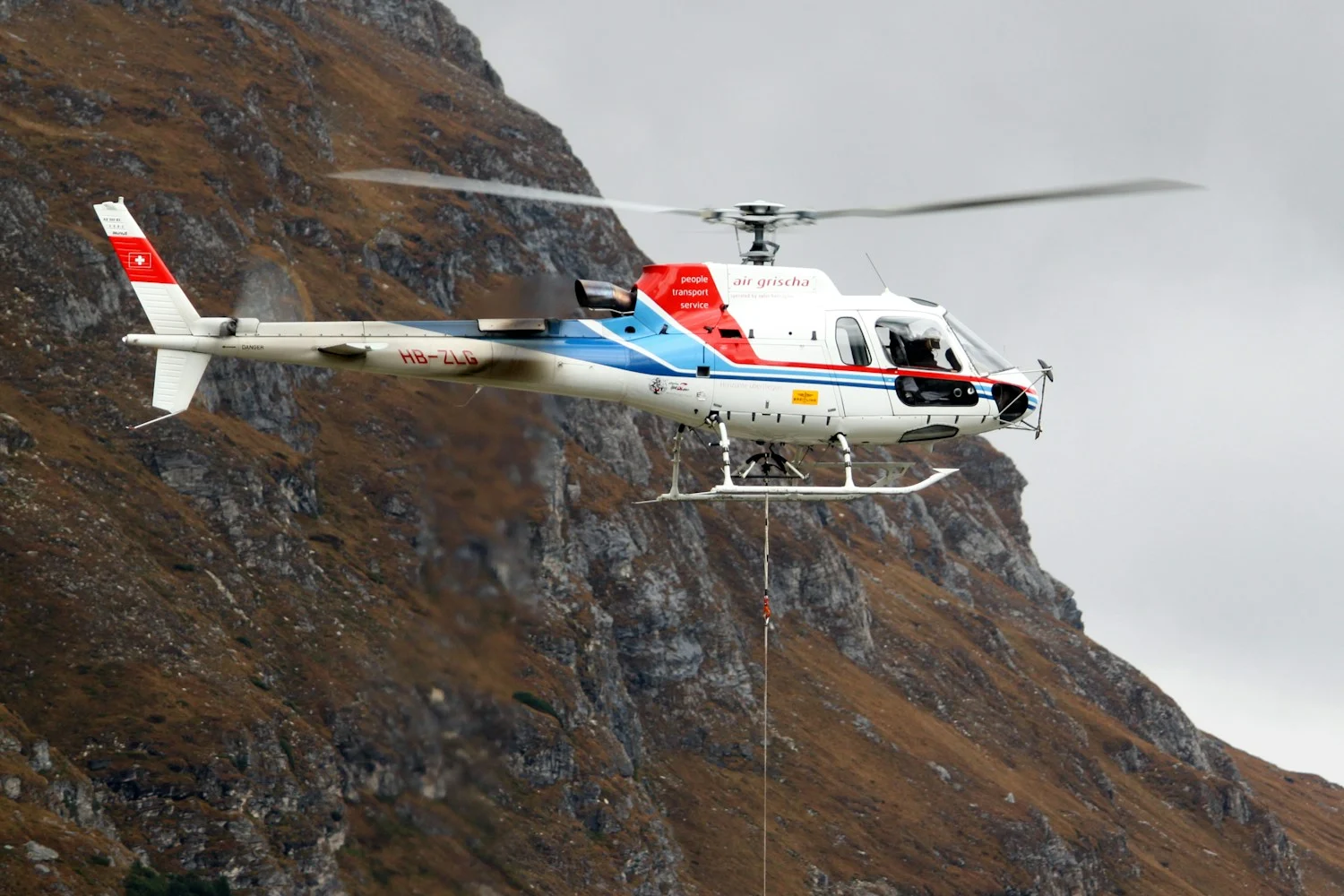
Fridolin Santer worked as an avalanche-blasting expert. His employer had a contract with the Austrian operator Wucher Helicopter for the carriage of its staff. During the flight Santer held the helicopter door open and dropped explosives — the task he was employed to perform. He was injured.
The court of first instance upheld his claim: he was a passenger injured on board. The appellate court confirmed liability but held that he was not a passenger within the meaning of the Montreal Convention, because the purpose of the flight was work rather than carriage from one place to another. The carrier and its insurer went further on appeal to the Oberster Gerichtshof, arguing that Santer was not a passenger but a member of the crew and so had no claim at all. The Austrian Supreme Court referred the question to Luxembourg.
Checked in August 2026
Citations and wording verified against primary sources: the judgment on EUR-Lex, and the versions of the Ukrainian Air Code and of Aviation Rules No. 768 in force after State Aviation Administration order No. 254 of 4 September 2025.
Two Questions, and the Court's Answer
There were two questions: whether a person carried under a contract between the carrier and that person’s employer, in order to perform a specific task, is a ‘passenger’ within Article 3(g) of Regulation (EC) No 785/2004; and whether that notion is the same as ‘passenger’ in Article 17(1) of the Montreal Convention.
By its judgment of 26 February 2015 in Case C-6/14 the Court (First Chamber) answered yes to both.
On the first, the Court proceeded from the definition in Article 3(g): a passenger is any person on a flight with the consent of the air carrier or the aircraft operator, excluding on-duty members of both the flight and cabin crew. Santer performed no task characteristic of the flight crew. That he opened the door on the pilot’s instruction does not make him cabin crew: a pilot may give instructions to anyone on board, passengers included.
On the second, the Court noted that Article 3(1) and (2) of the Convention tie passenger status to the delivery of a document of carriage — but Article 3(5) states that non-compliance with those provisions does not affect the existence or validity of the contract of carriage, which remains subject to the Convention including its limits of liability. Since Santer was carried under a contract from the point of departure to the site of the work and back, the purpose of the flight was precisely the carriage of employees. A person who is a passenger under the Regulation is therefore also a passenger under Article 17, once carried under a contract of carriage.
The Ukrainian Definition Says the Opposite
Now Article 1 of the Air Code of Ukraine: a passenger is “a natural person carried by an aircraft with the consent of the carrier under a contract of carriage, other than members of the crew and additional specialists on board, employees of the aircraft operator, an authorised representative of the relevant national regulator, and persons accompanying cargo”.
“Additional specialists on board” is exactly Santer. Where EU law says “a passenger, because not crew”, Ukrainian law says “not a passenger, because a specialist”. The Code’s carve-out is materially wider than the Regulation’s: the latter excludes only on-duty flight and cabin crew; the former also excludes specialists, operator’s staff and cargo attendants.
This is not a drafting curiosity. Aviation Rules No. 768 state in their preamble that they incorporate Regulation 785/2004 — the instrument listed in the Annex to the EU–Ukraine Common Aviation Area Agreement. The divergence is therefore with an act Ukraine has undertaken to approximate.
What the Classification Costs
The difference between the two answers is measured in limits, not in theory.
If the person is a passenger, the carrier’s liability cover responds: under Aviation Rules No. 768 the minimum sum insured for damage causing the death or bodily injury of a passenger is 250,000 SDR per passenger.
If the person is an employee of the client for aerial works, they fall into a different class of insurance. The same Rules state expressly that persons entitled to be on board lawfully without a ticket cannot include employees of the client for aerial works, employees of other organisations involved in such works, or persons supporting the technological process (unless they are the operator’s own staff). For them the Rules provide personal accident cover with a sum insured of not less than UAH 300,000 per insured person.
These are different instruments by nature — carrier’s liability and personal accident — and in principle they can coexist. But the practical effect is plain: the classification decides which way the insurer looks and what the injured person can claim. The orders of magnitude differ by roughly two decimal places.
There is a further reason the classification matters. Under Article 21 of the Montreal Convention the carrier’s liability to a passenger is two-tier: up to the first threshold — 100,000 SDR in the text of the Convention, 151,880 SDR after the five-yearly revisions — the carrier is liable regardless of fault. Above that threshold it escapes only by proving that the damage was not due to the negligence or other wrongful act or omission of the carrier, its servants or agents. Everything above the threshold therefore turns on a concept that Ukrainian legislation does not define at all. The firm’s partner Ganna Tsirat proposed such a definition using air carriage as the very example — “The Concept of Negligence and Its Substance” (Yurydychna Gazeta, 2018, No. 38 (640), pp. 22–23, PDF, in Ukrainian).
Carrying people your paperwork does not call passengers? Describe the operation — we will tell you which liability regime a court would apply and how to paper it before an incident.
What a Carrier and a Client Should Do About It
First, separate international carriage from domestic aerial works. For carriage falling under the Montreal Convention the Convention’s autonomous notion governs, not the Code’s definition — Article 3(2) of the Air Code gives priority to the rules of an international treaty. Relying on the national “additional specialists” carve-out in such a dispute is unwise.
Second, write into the aerial works contract what the parties take the people on board to be, and do not leave it to construction. The wording “carriage of the client’s employees to the work site and back” is precisely what allowed the Court to see a contract of carriage.
Third, test the cover against both scenarios. If the policy only provides accident cover for aerial works personnel and a court treats those people as passengers, the difference is paid by the carrier.
Fourth, remember the ticket. Its absence proves nothing — Article 3(5) of the Montreal Convention closes that argument.
For the wider regulatory picture see our overview of the key rules of Ukrainian aviation law, and for how war and other risks are to be covered before flights resume, the insurance facility a restart requires.