
International Contracts | JVS Law
China is by a wide margin the largest supplier of goods to Ukraine. In the first half of 2026 imports from the PRC came to USD 13.9 billion, against USD 0.78 billion of Ukrainian exports going the other way. This is not a two-way exchange but a procurement channel, and in it the Ukrainian company almost always pays first.
Contents
- 1 Why is it worth conducting due diligence on Chinese companies
- 2 Main sources for checking Chinese companies
- 2.1 National Credit Information System (NECIPS)
- 2.2 Court Enforcement Information Disclosure Platform
- 2.3 China Judgments Online
- 2.4 Credit Publicity Platform of Customs
- 2.5 Pledge Register (Movable Property)
- 2.6 Can Real Estate Ownership Be Verified in China?
- 3 Basic checklist
- 4 Checking a company for presence on sanctions lists
- 5 What cannot be verified
- 6 Conclusion
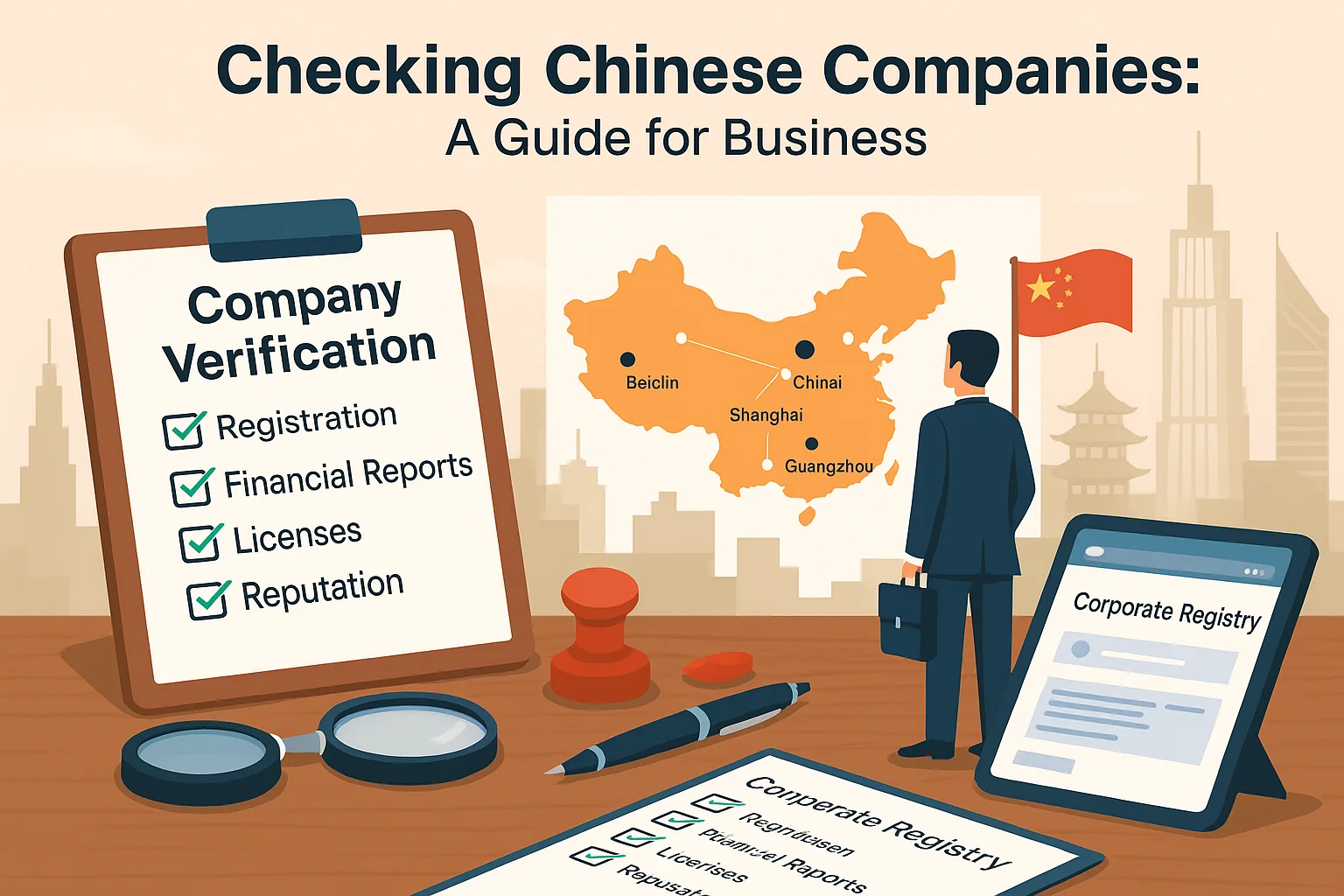
Which is why the main risk here is not a dispute but a prepayment to a company that does not exist, or that exists but has no right to trade in what it is selling. Checking the counterparty is the cheapest action with the largest effect anywhere in the chain.
Below: where to look for information on a Chinese company, what each source actually shows, and what cannot be verified from outside China at all. How this fits into the trade structure and into the contract itself is covered separately: the structure of Ukraine’s foreign trade and what it means for your contract.
In short
Screening a Chinese supplier is not bureaucracy — it is how you avoid losing a prepayment. The basic data is open and free, and takes a few hours. What is closed off is real estate and true financial standing.
Why is it worth conducting due diligence on Chinese companies
Import volume says nothing about the reliability of any particular supplier. The scenarios we see in practice come down to three:
- The company does not exist in the form set out in the contract. The name on the invoice does not match the register, the registered address is different, and the signatory is not the legal representative.
- The company exists but is an intermediary. It sells equipment while its registered scope of business covers neither manufacturing nor foreign trade; when a quality problem arises, there is no one to answer for it.
- The company is already insolvent. It sits on the register of judgment defaulters, or its assets are pledged.
All three are visible in open sources before signature. Here is where.
Main sources for checking Chinese companies
National Credit Information System (NECIPS)
National Enterprise Credit Information Publicity System — 全国企业信用信息公示系统, the principal database covering every legal entity and entrepreneur registered in the PRC. It is the equivalent of Ukraine’s unified state register. The system is Chinese-language only and frequently will not open from outside China without a proxy or a local agent.
What it shows:
- registration number and unified social credit code;
- full and short company name, entity type and form of ownership;
- registered capital, date of registration, registering authority;
- company status — active, in liquidation, dissolved;
- licence validity, registered address, scope of business;
- shareholders and their holdings, management, the legal representative;
- branches and subsidiaries.
Companies must report changes — name, shareholders, director — within 30 days, so the data is reasonably current.
In short
NECIPS is the entry point. If the data does not match the contract or the invoice, there is no need to go further — that is already a red flag.
Court Enforcement Information Disclosure Platform
中国执行信息公开网, run by the Supreme People’s Court, lists companies and individuals who have failed to comply with court judgments. Being on it means:
- exclusion from public procurement;
- restrictions on licences and subsidies;
- risk of frozen bank accounts;
- personal restrictions on management — down to bans on business-class flights and high-speed rail.
In short
A company on this register cannot function normally inside China. Prepaying such a counterparty is not a risk, it is a decision.
China Judgments Online
中国裁判文书网 publishes judgments involving companies — contract disputes, bank debt, employment claims. Judgments touching state secrets or the rights of minors are not published.
What matters is not whether cases exist — any large company will have them — but their type and recurrence. A pattern of losses under supply contracts, or repeated claims by raw-material suppliers, tells you more than one large case does.
In short
Read the pattern, not the count. A run of supply-contract recoveries means the company does not pay its own counterparties.
Credit Publicity Platform of Customs
The General Administration of Customs register — 中国海关企业进出口信用信息公示平台 — covers companies registered as importers or exporters:
- type of operations and position in the supply chain (manufacturer, intermediary, agent);
- the credit category assigned by customs;
- customs violations;
- special permits held.
This source often answers the question that matters most: is your counterparty actually a manufacturer or a reseller. A “discredited enterprise” rating brings enhanced inspection, which in practice means delays at the border.
In short
This shows whether the company may conduct foreign trade at all, and how its own customs authority rates it.
Pledge Register (Movable Property)
Since 2021 the Credit Reference Centre of the People’s Bank of China has maintained a unified register of security interests over movable property — 动产融资统一登记公示系统. It covers equipment, raw materials, finished goods, warehouse receipts and receivables.
In short
Pledges are not damning in themselves — working-capital finance is normal. What should worry you is a pledge over the very equipment that is supposed to produce your order.
Can Real Estate Ownership Be Verified in China?
For a long time China had no single system for registering rights in real property; records were kept at provincial level. In April 2023 the government announced completion of a National Real Estate Registration System covering more than 3,000 registration districts.
In theory this could serve due diligence — confirming whether a counterparty really owns the production premises or warehouses its offer describes. In practice, it does not.
Access to the register is closed. Only the owner or an authorised person — a lawyer or a state body — can obtain an extract, by written request and on payment of a fee. There is no open online database of the kind Ukraine has. Searching by address or by company name is technically impossible for an outsider.
In short
The centralised system exists but is not public. Verifying a counterparty’s real estate from abroad is impossible without a local representative.
Basic checklist
The order matters: each step is worth taking only if the previous one produced no red flag.
- NECIPS — status, address, registered capital, management, scope of business.
- Reconcile against the documents. Name, code and address in the register must match the invoice and the draft contract. A mismatch in the unified social credit code is a stop.
- Defaulter register and judgments database — does the company comply with judgments, and what is it being sued over.
- Customs register — is it entitled to trade internationally, and is it a manufacturer or an intermediary.
- Pledge register — is the property you are relying on already encumbered.
- Sanctions lists — a separate section below, and not one to skip.
- B2B platforms. If the counterparty trades through Alibaba, Made-in-China or similar: time on the platform, rating, reviews and — above all — how it handled earlier complaints.
A basic check can be done in-house given Chinese-language capability or access to a local agent. Bringing in counsel is worth it when the contract value is high, the earlier steps produced a mixed picture, or a written opinion is needed for a bank or an insurer.
Ordering from a Chinese supplier you have never met? Send the company name in characters — we will pull the registry file and run the sanctions screen before your prepayment leaves.
Checking a company for presence on sanctions lists
Chinese companies, state-owned and private alike, increasingly fall under restrictions imposed by the United States, the EU, the United Kingdom and Ukraine. Dealing with one leads to payments blocked at banks that observe sanctions regimes (particularly in dollars and euro), goods held at the border, and financial-monitoring questions directed at you.
Where to check:
- United States — OFAC: sanctionssearch.ofac.treas.gov. Search by the English name, and keep the 50 Percent Rule in mind: an entity owned by designated persons is itself treated as designated even if it is not named on the list.
- European Union — EU Sanctions Map: sanctionsmap.eu.
- United Kingdom — UK Sanctions List: gov.uk.
- Ukraine. Two different resources here, and they should not be conflated. The legally binding list is the State Register of Sanctions maintained by the NSDC staff: sanctions are imposed by NSDC decision and enacted by presidential decree. The NACP portal War & Sanctions is analytical — convenient for searching and for seeing which other jurisdictions have designated a person, but presence or absence there is not in itself a legal fact.
If the company turns up on a list, that is not automatically the end of the negotiation. Establish the nature of the restrictions first: they may be sectoral, goods-specific or financial, and not all of them touch your particular transaction. But make no prepayment and sign nothing until you have a legal opinion.
Check the goods themselves separately: equipment, components and materials of dual-use character fall under the export control regime, which applies whether or not the counterparty is sanctioned.
In short
Sanctions screening is the one step that protects you rather than the counterparty: a bank will stop the payment without explanation, and recovering the money will be your problem.
What cannot be verified
The honest boundary of this guide. Open Chinese sources give you a company’s legal profile. They do not give you three things — and those are where deals usually fail.
- Real financial standing. Registered capital in NECIPS is declared, not necessarily paid in, and private companies do not publish accounts. Whether the company can actually fund your order is not visible in any register.
- Production capacity. Real estate is closed, and the photographs in a commercial offer may show someone else’s workshop. This is verified by inspection on site, not online.
- Who really controls the company. The register shows shareholders and the legal representative, but not nominee holdings or links to other structures.
Hence the practical conclusion: register checks remove the “the company does not exist” risk and barely touch the “the company cannot deliver” risk. The second is closed not by screening but by the structure of the contract — payment terms, pre-shipment inspection and a dispute clause that actually works. Which clause works with a Chinese counterparty is set out separately: the arbitration clause in a dispute with a Chinese partner.
Conclusion
China’s state registers are complex, only nominally multilingual and scattered across different authorities — but they are open. A few hours of work with them removes the most expensive category of loss: a prepayment to a company that does not exist or has no right to do what it is selling.
What they do not do is replace the contract. Screening tells you who you are dealing with; what protects you is what the agreement says.
Need a Chinese supplier checked before you pay?
We screen Chinese counterparties — from a quick register-based snapshot to a written opinion with legal assessment for a bank or an insurer — and then draft or revise the contract itself. Send us the company name and the unified social credit code; we reply within one business day.
Dr Anna Tsirat: profile and enquiry form →
Practice: Legal Due Diligence · Contracts with Ukrainian Companies
Updated 13 August 2026. Trade volumes: State Customs Service of Ukraine, first half of 2026. Register addresses were checked on the update date; Chinese state resources are frequently unreachable from outside the PRC, which is not an indication that the register is down. Sanctions lists change constantly — check them immediately before payment, not at the negotiation stage.
The author is a Doctor of Laws and leads the firm’s contract practice. Related material: the structure of Ukraine’s foreign trade and arbitration or court in a cross-border contract.