
Dispute resolution | JVS Law
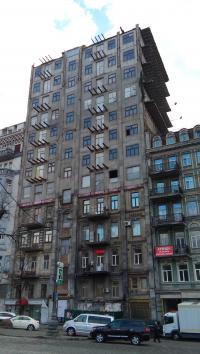
Annulling a permit and pulling a building down are two different cases, and the second one takes far longer. The building at 2-A Muzeinyi Lane in Kyiv demonstrates it almost in laboratory conditions.
Contents
Firm partner Anna Tsirat ran the matter pro bono as counsel for Kyiv City Council, in the Commercial Court of Kyiv and the Kyiv District Administrative Court at the same time.
What happened there
A historic building beside the National Art Museum of Ukraine had permission to add attic and mansard storeys. Instead the developer put up eight full residential floors without authority.
The building was formally commissioned, but the look of it said otherwise: plywood in the window openings, rubbish in the yard, reinforcement bars where balconies had been planned. The development had been in the press since 2014.
Why one claim was not enough
Kyiv City Council asked the Commercial Court to order demolition. The court could not do it while valid documents were still in place certifying that what had been built matched the design documentation and planning law.
The paperwork had to go first. That produced the second claim, in the District Administrative Court against the State Architectural and Construction Inspectorate and other authorities: to declare unlawful and annul the decisions issuing the conformity certificates on which the apartment ownership titles in the unlawful floors were later based.
On 16 June 2015 the Kyiv District Administrative Court granted it. The conformity certificates issued by the Kyiv architectural and construction control inspectorate were annulled; so were the ownership titles to the apartments on those floors, together with the entries registering them. The court held that the authorities had acted unlawfully in issuing the certificates.
Ukrainska Pravda reported it on 8 July 2015, quoting Pavlo Riabikin, then deputy head of the Kyiv city administration, saying it would “not be our last win”.
What happened next
Then came the part that press releases rarely cover.
In September 2017 a panel of the unlawful superstructure collapsed inward on the tenth floor — reported by Hmarochos, citing MP Boryslav Bereza. A structure whose legality the court had already undone went on to demonstrate its physical quality as well.
For contrast, the unlawful superstructure over the Trade Unions Building, part of the same 2015 campaign, was taken down.
We have found no public record that the floors at Muzeinyi Lane were ever demolished. As at August 2026 we have no confirmation of enforcement. If you hold a document showing otherwise, tell us and we will update this page.
What to take from it
Three things recur in cases like this:
- The permits are the first line, not a detail. While a conformity certificate stands, no court will order demolition: it cannot disregard a document that formally certifies legality.
- Annulling ownership hits third parties. Along with the certificates the court annulled the titles of people who had bought apartments on those floors — and that is where cases of this type usually bog down.
- A judgment and its enforcement run on different clocks. Winning on the permits is not the same as a demolished structure. Anyone planning such litigation should budget for the second stage from the start.
A dispute over development, permits or title?
We work out where to start: challenging the permits, seeking demolition, or attacking the registration of title. We tell you plainly how many stages lie ahead and where the process will run into enforcement. Describe the situation and we will respond within one business day.
Anna Tsirat: profile and contact form →
Practice: Dispute Resolution in Ukraine
Originally published on 16 July 2015. Rewritten in August 2026; the later course of the case is described from the public sources cited above.