Last updated: May 2026
About the Textbook
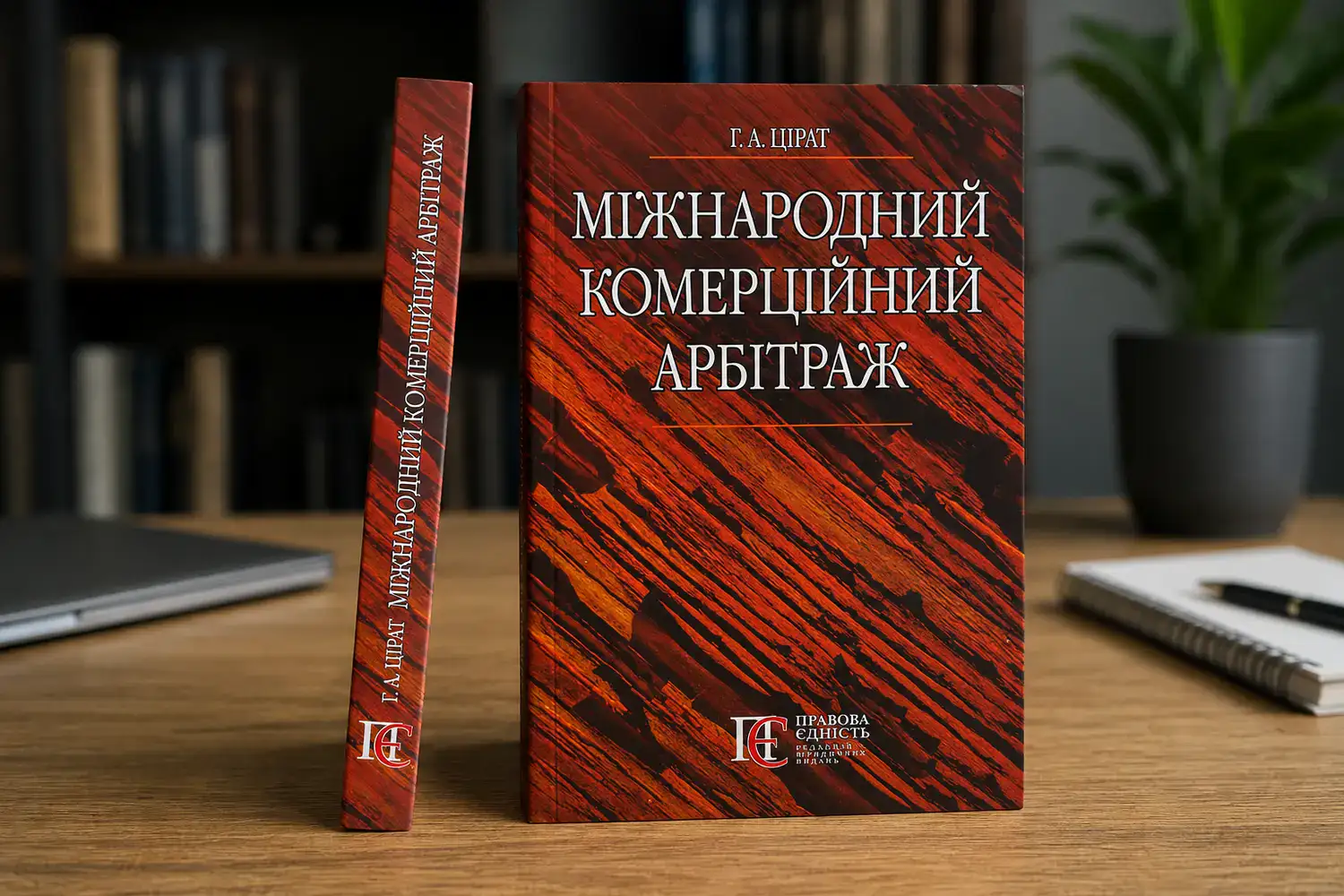
In 2019, Gennadii Tsirat, Doctor of Law, Associate Professor at the Department of International Private Law of the Institute of International Relations of Taras Shevchenko National University of Kyiv, published the textbook “International Commercial Arbitration”.
Gennadii Tsirat has been teaching this course since 1998 and has summarised it in two textbooks published in 2002 and 2019, as well as in course syllabi and other methodological materials.
The 2019 edition is the most comprehensive and authoritative printed version of this course, in which international commercial arbitration is examined as a complex and highly specific legal phenomenon in the field of resolution of cross-border (international) commercial disputes.
Textbook Contents
The textbook is divided into Chapters, each dedicated to a particular aspect of international commercial arbitration.
As an introduction to the course, the textbook provides a general definition and description of arbitration as an alternative to litigation for resolving cross-border commercial disputes, and offers a comparison of arbitration and state courts across the key aspects of resolving private-law cross-border commercial disputes.
Various types of arbitration are examined: ad hoc arbitration and permanent arbitral institutions; universal and specialised arbitral institutions. Attention is given to the legal status and structure of the governing bodies of arbitral institutions, the specifics of their rules, recommended lists of arbitrators, their purposes and operational procedures. The textbook highlights trends in the development of international commercial arbitration worldwide in recent decades and its role in the system of international trade and investment regulation.
Arbitration agreements as the foundation of arbitration are examined in the context of their regulation by key international conventions and national legislation. The range of persons and entities for whom an arbitration agreement produces legal consequences is defined, including the exclusion of certain disputes from the jurisdiction of state courts, the conferral of authority on arbitrators to resolve the dispute, established procedures, and the rights and obligations of the disputing parties.
In the context of enforcing an arbitration agreement, the textbook addresses the institution of declining jurisdiction by a state court (challenging the jurisdiction of a state court), identifies its problematic aspects, and cites illustrative court cases.
Given the specific legal nature of an arbitration agreement, which combines elements of a civil-law transaction and a procedural agreement and constitutes an agreement with a foreign element, such important issues as the permissibility of an arbitration agreement (arbitrability of a dispute), the validity of an arbitration agreement, and the problems of determining the law applicable to the arbitration agreement are examined.
Challenges to the validity of an arbitration agreement and objections to the arbitral tribunal’s authority to resolve the dispute are examined in the context of the institution of jurisdictional challenge of the arbitral tribunal.
The procedural conditions for applying this institution within the framework of the competence-competence doctrine are examined, under which the exclusive right to decide on jurisdictional challenges belongs to the arbitral tribunal, with the possibility of judicial review of preliminary rulings on jurisdiction by state courts.
Using the rules of several well-known permanent arbitral institutions and the UNCITRAL Rules for ad hoc arbitration as examples, the textbook identifies the main stages of arbitral proceedings — from the initiation of the arbitral procedure, the formation of the arbitral tribunal, and payment of advances on arbitrators’ fees, to the hearing of the case on its merits, oral hearings, and the rendering of a final arbitral award. The procedure for rendering and signing the arbitral award, the detection and correction of errors, the provision of clarifications on its content, and the rendering of an additional arbitral award are examined.
Special court procedures for setting aside an arbitral award are considered separately, as a specific form of judicial control in the state of the seat of arbitration over the activities of international commercial arbitration, notwithstanding the fact that an arbitral award cannot be the subject of appeal or cassation in the courts of any state.
The grounds for setting aside an arbitral award, the specifics of the court procedure, and the legal consequences of setting aside an arbitral award are detailed, with illustrative court cases provided.
The final chapters of the textbook are devoted to court procedures for the recognition and enforcement of arbitral awards, both foreign and domestic. They provide a thorough analysis of the key instrument in this area — the 1958 New York Convention on the Recognition and Enforcement of Foreign Arbitral Awards, national and foreign court practice, the interpretation of grounds for refusal of recognition and enforcement of arbitral awards under Article V of the New York Convention, the procedural aspects of such cases, and illustrative court decisions.
Second Edition — 2027
In the meantime, we recommend the new textbook by Gennadii Tsirat — “International Civil Procedure” (Yurincom Inter, 2026, 448 pp.), dedicated to fundamental issues of international civil procedural law.
About the Author
Gennadii Tsirat — founding partner of JVS Law, Doctor of Law, Associate Professor at Taras Shevchenko National University of Kyiv. Over 35 years of experience in international commercial arbitration, enforcement of arbitral awards, and expert opinions on Ukrainian law. Co-author of the annual Civil Procedure in Ukraine (Kluwer Law International), author of six monographs.